June News

MUNICIPALITY OF COTACHI FORMALLY DENOUNCES BHP OVER CONCESSIONS IN THE AREA

23 JULY 2018

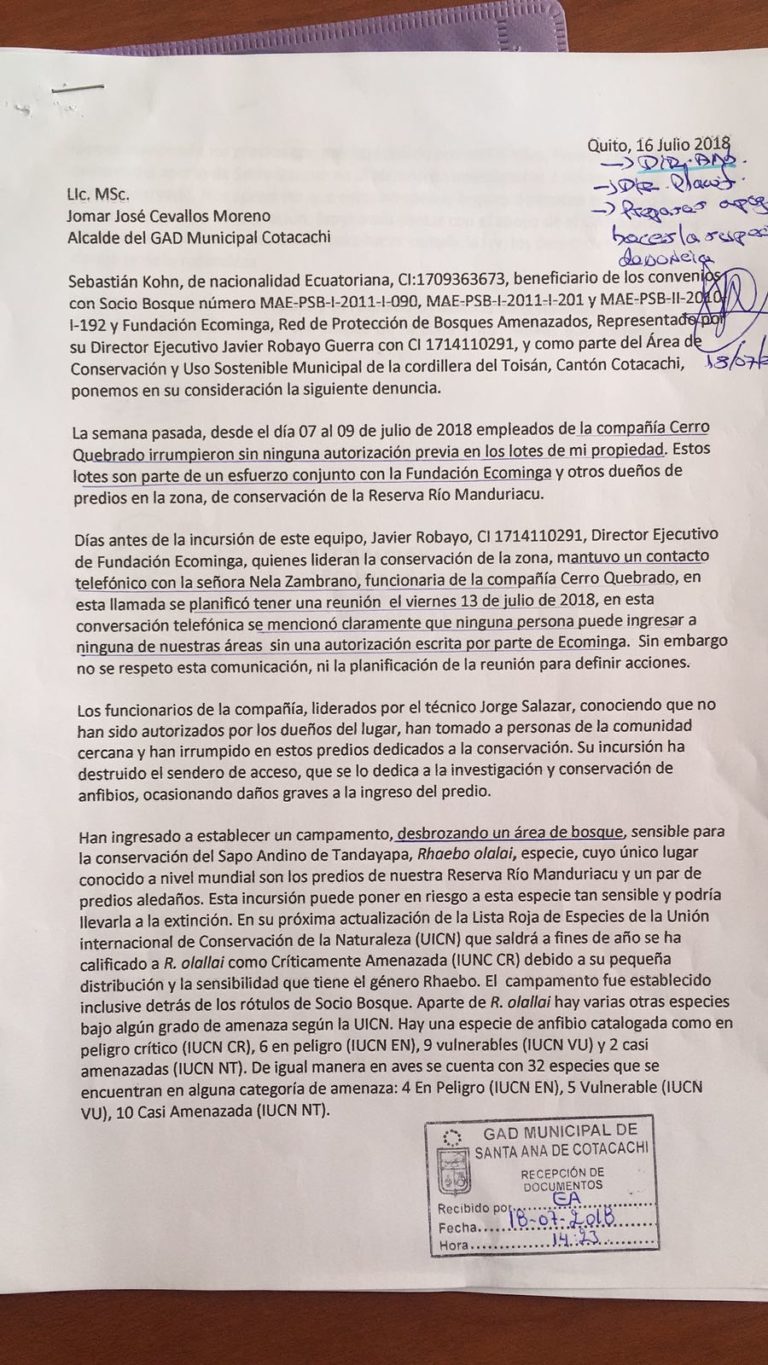
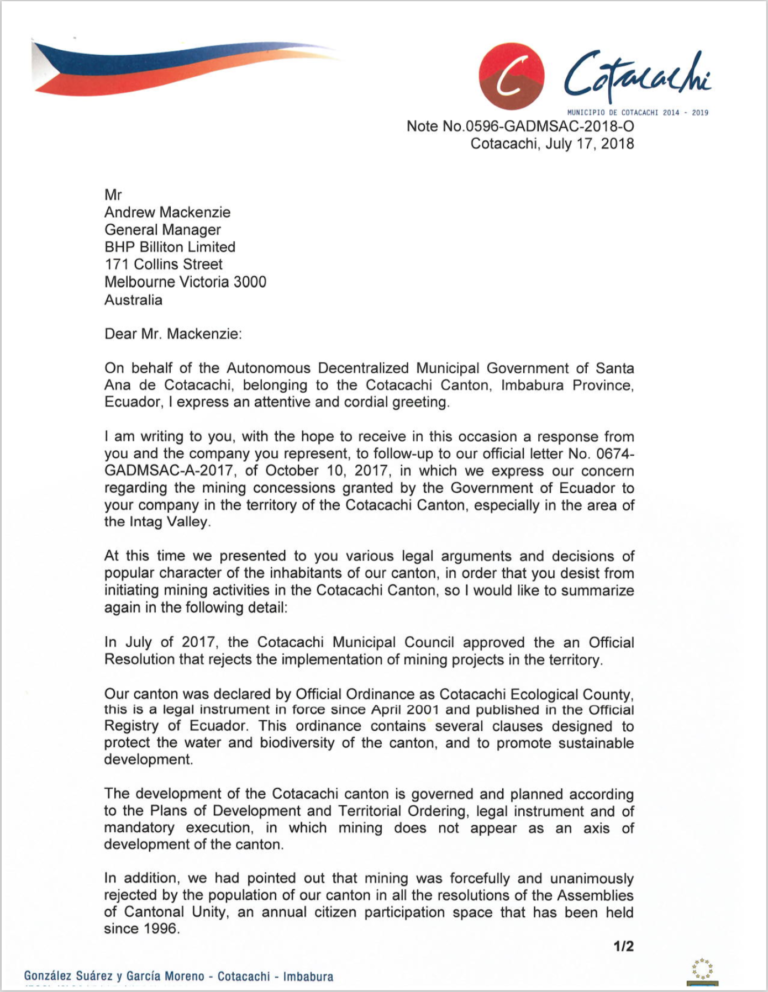
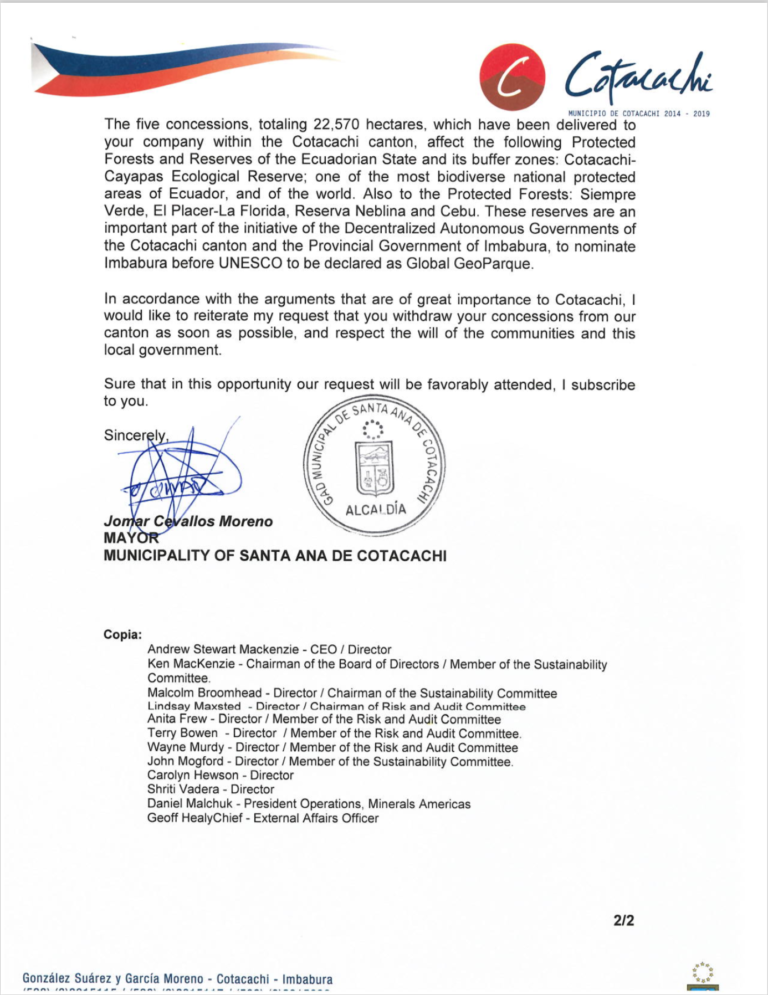
Today, the Mayor of the Cotacachi Municipality in the Imbabura Province of Ecuador, issued a formal denunciation to BHP Billiton over their mining concessions in the area, with particular concerns over their transgressions in protected reserves and conservation areas.

Mining concessions totalling 22,570 hectares were given to BHP in the Cotacachi Canton despite unanimous rejection by the population of the canton, and in direct opposition of the wishes of local council.

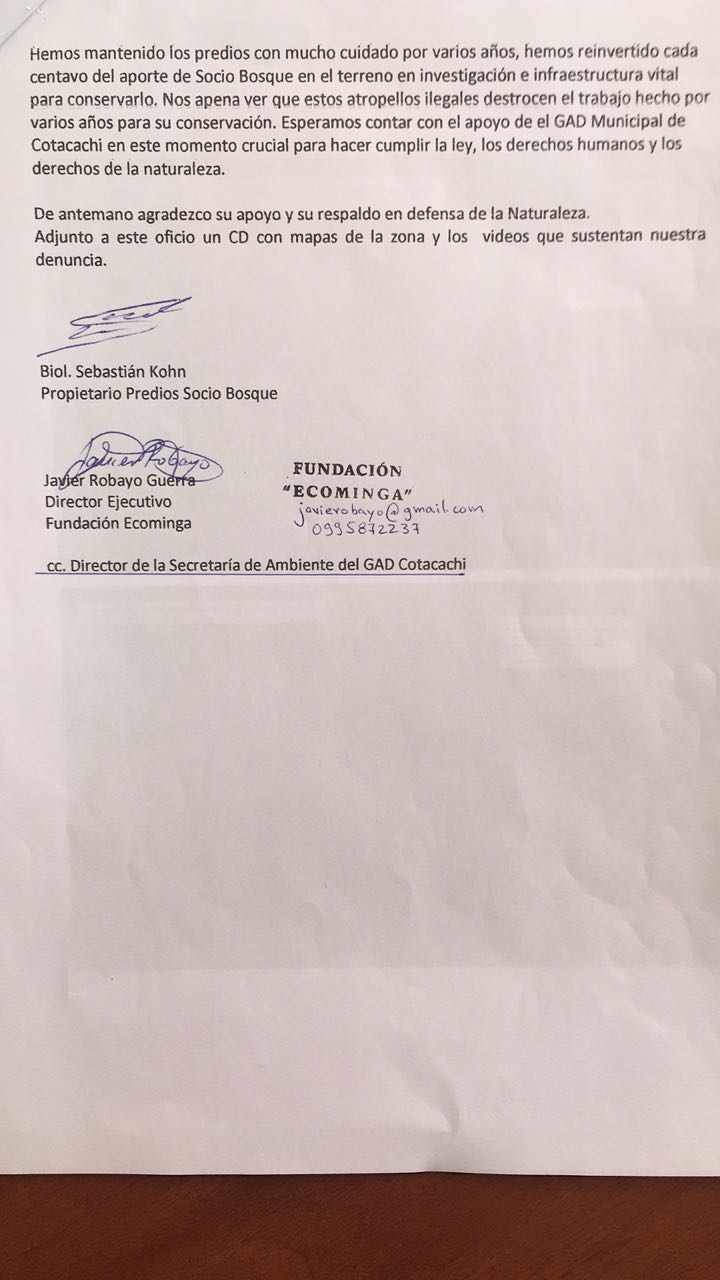
The EcoMinga Fundacion, an Ecuadorian conservation organisation, raised concerns to the Cotacachi Municipality on the 16th of July over BHP employees illegally trespassing onto their property  despite formal agreements with company spokespeople banning entry by employees without consent. The employees entered between the 7th and 9th of July, clearing an area of forest for a camp, which is sensitive habitat for the Rhaebo Olalai, an extremely rare Andean toad.

EcoMinga is located west of the Los Cedros Biological Reserve, and is dedicated to the conservation of the unique foothill forests, cloud forests, and alpine grasslands (“paramo”) of the Andes, especially those on the edge of the Amazon basin in east-central Ecuador and those on the super-wet western Andean slopes of the Choco region in northwest Ecuador. EcoMinga has established seven reserves in the upper Rio Pastaza watershed in east-central Ecuador between Banos and Puyo. Most of these reserves adjoin national parks, which protect higher-elevation habitats. The reserve extends protection down into the much more diverse middle and lower elevations which are not protected by national park status.


LOCAL PARISH UNOFFICIALLY VOTES TO PROHIBIT MINING IN INTAG REGION

29 JUNE 2018

The Parish Government of Cuellaje is one of four affected by the mining concessions in the Intag region. At the meeting attended by 500-1500 people, they voted overwhelmingly to:
* Ask the government to revert all mining concessions in the Parish and the rest of Intag
* Convene an Intag-wide Assembly to ask all mining companies to leave the Intag area
* Change the Teniente político of Cuellaje (an executive appointee that is facilitating mining socialisation)
* Prohibit the presence of government and mining companies employees involved in socialisation in all the communities
* For all of Intag to join forces.
This decision is significant in the wake of the rejection of the socialisation process in the nearby Parish of Peñaherrera.
Note: This is an unofficial resolution. The local government is yet to publish the official one.


Report shows new mining concessions could severely decrease biodiversity and ecosystem services in Ecuador.

Our results reveal the potential losses that mining could cause: eight critically endangered species, including two primates (brown-headed spider monkey and white-fronted capuchin), 37 endangered species, 153 vulnerable, 89 near threatened, and a large number of less threatened species... The short-term national profits from mining will not compensate for the permanent biodiversity losses, and the long-term ecosystem service and economic losses at the local and regional level.

Read more


ECUADOR'S EXTRACTIVE POLICIES AND THE SILENCING OF DISSENT

BY CARLOS ZORILLA

Ecuador's policy of silencing NGOs that question government policies and programs has gotten the world's attention. UN experts on human rights claim it is a strategy to asphyxiate civil society.

Cuban-born Carlos Zorilla has lived for more than 35 years in Ecuador, where he is a leading activist opposing extractivism. He is the co-founder and former President of DECOIN (Defensa y Conservación Ecológica de Intag), which works to protect the environment and promote the sustainable development of the Intag Valley in North Western Ecuador.

Read more at Open Democracy


In 2013, Shuar leader José “Pepe” Acacho was controversially found 'guilty' of terrorism offences for protests undertaken in 2010, and sentenced to 8 years jail.
The Correa government sought to ban Acción Ecológica for supporting the Shuar nation in 2016. Acción Ecológica activists were repeatedly harassed, including sexually assaulted.
The former Correa government passed laws to deeply regulate NGOs, attempting to silence journalists, tribal leaders and activists alike.

RIO BLANCO MINE SUSPENDED

3 JUNE 2018

Cuenca judge Paúl Serrano has ordered the temporary suspension of mining operations at the Río Blanco gold and silver mine near the Cajas Mountain community of Molleturo. The order also calls for a demilitarization of the area around the mine, which is currently guarded by 150 police and military personnel. The suspension order will be in effect for 25 days as data about the impact of the mine on water sources is reviewed by the Universities of Cuenca and Azuay.

Read more at Telesur
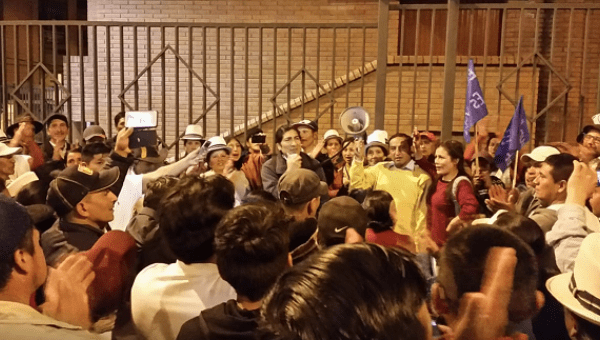
Activists celebrate around Yaku Perez, Ecuarunari president, on Friday night in Cuenca after a judge ruled to suspend mining activities at the Junefield Rio Blanco site. Photo: Yasunidos

OIL & GAS EXTRACTION IN INDIGENOUS TERRITORIES

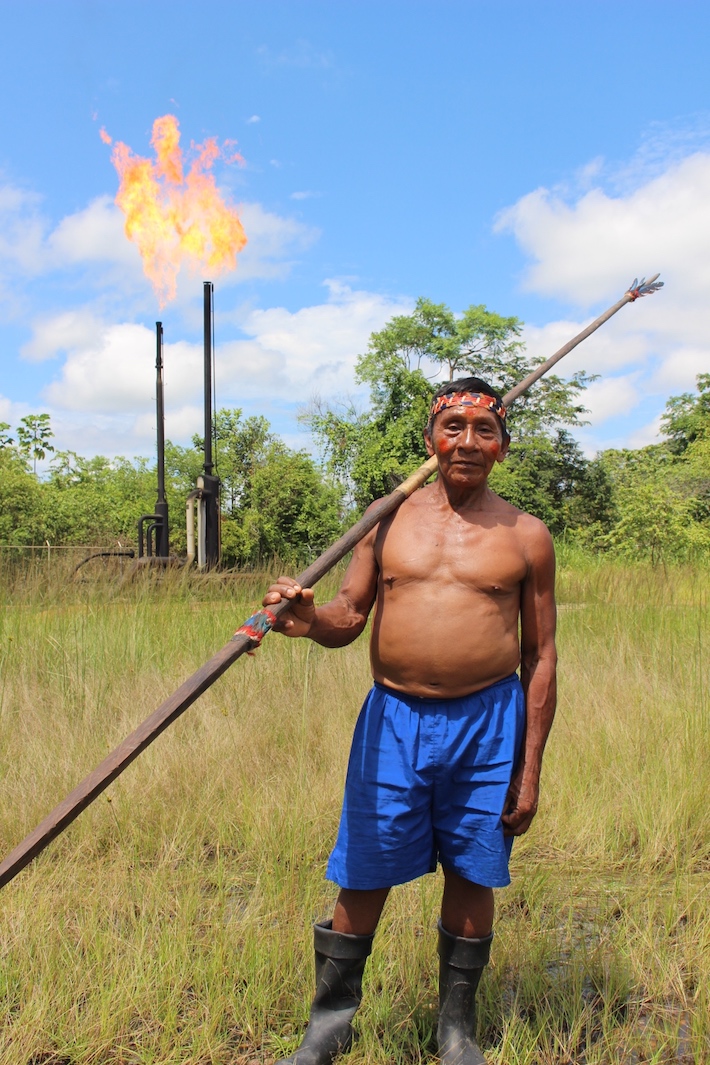
After learning how oil contamination has affected other indigenous communities, the Waorani people from Pastaza province in Ecuador plan to challenge a possible drilling concession in their own Amazonian territory using a strategy they call “spear and law.”

Nenquimo also serves as the voice of the Waorani people to the others in attendance. “We have always defended our territory and our elders,” he says, relaying the message of a Waorani woman. “We still have the present moment to fight and defend our territory; we want to leave this territory healthy for the young people from future generations. We want them to live without contamination and without harm to their health.”

Read more in Mongabay
SENATOR LEE RHIANNON QUESTIONS AUSTRADE'S SUPPORT FOR MINING IN ECUADOR'S PROTECTED FORESTS

1 JUNE 2018

Mining Concessions in Ecuador

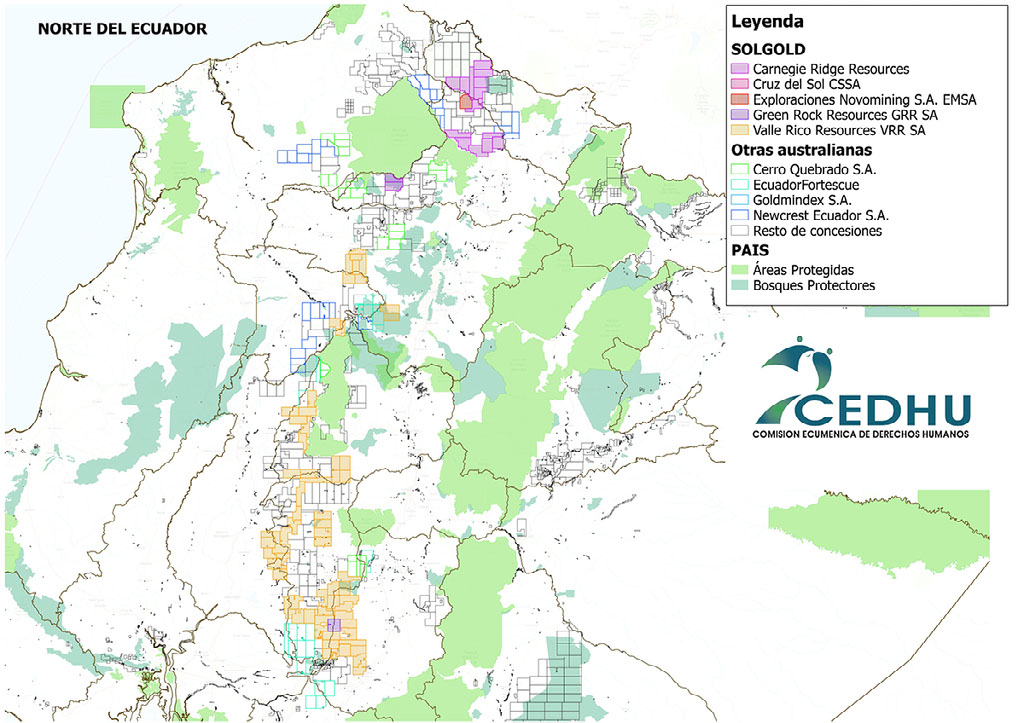
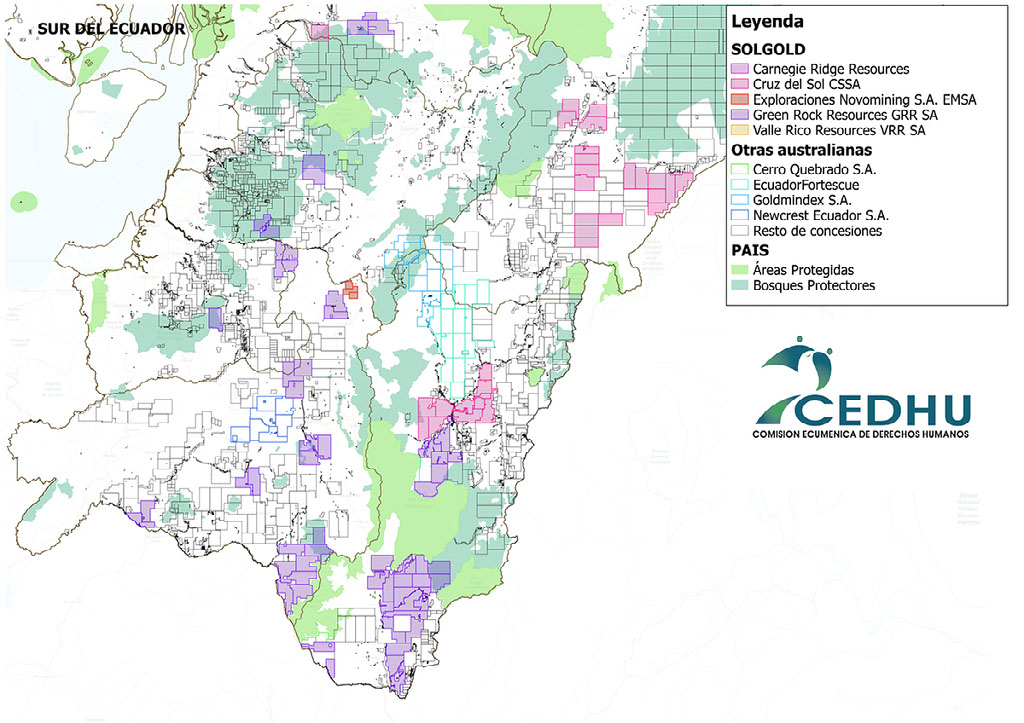
Many of the mining concessions being handed out in Ecuador are within protected forests and indigenous reserves in outright violation of Ecuador's Constitution.  No prior consultation occurred with affected communities.

The degradation of protected areas, such as Bosques Protectores (Protected Forests), and the spread of mining roads and camps (and eventually mines) within the buffer zones of globally significant areas like the Cotacachi-Cayapas Ecological Reserve, risks hundreds of species listed by the International Union for Conservation of Nature (IUCN) as threatened, endangered or vulnerable.

Mining represents a short-term investment with great long-term costs to the people of Ecuador. We cannot maintain the illusion that mining can be done without grave ecological and human health consequences, consequences that are well documented in scientific literature.


At a referendum in February 2018, 67% of Ecuadorians voted overwhelmingly to roll back mining, particularly in forested areas. Despite this, mining concessions continue to be handed out.

MINING CONCESSIONS IN PROTECTED FORESTS

CREDIT: COMISION ECUMENICA DE DERECHOS HUMANOS

LOS CEDROS

NON-PROFIT BIOLOGICAL RESERVE

One of the protected areas conceded to Australian mining companies is the Los Cedros Biological Reserve which was set up with the help of the Australian Rainforest Information Centre almost 30 years ago, along with a substantial grant from AusAID.

The Los Cedros Biological Reserve consists of 17,000 acres of incredibly rare, premontane wet tropical forest and cloud forest, one of the most biologically diverse and endemic habitats on Earth.  Over 95% of this forest type has already been lost.

Los Cedros is not accessible by road, and for this reason has been - until now - both better protected, and less scientifically explored than some other Protected Forest reserves in Ecuador. The biodiversity in this last intact watershed is remarkable, yet most of it remains to be discovered and understood.

Scientists have found in Los Cedros:

2 critically endangered species

24 endangered species

99 species listed as vulnerable

59 threatened or near threatened species

Brown-headed Spider Monkey. Photo: David Ni Castro

Among the most significant animal species found at Los Cedros is the critically endangered brown-headed spider monkey (less than 250 remain in the wild), the neotropical otter, margay, puma, jaguar, and spectacled bear. Unsurprisingly, Los Cedros is also a bird hotspot. At least 298 bird species have been seen along the short trail system, including numerous endemic species found only in the cloud forests of the Chocó region, secretive species like the lanceolated monklet, and newly discovered species such as the cloud forest pygmy owl. Of the birds seen at the Reserve, at least 10 are endangered, threatened, vulnerable, or near threatened due to habitat loss. The forest is also extraordinarily rich in plant species. A field study estimated an average of 299 tree species per hectare, an estimated 400 orchid species (many of which were first discovered in the Reserve) and a very high number of local endemic species with small ranges.

For a page full of details of the incredible splendours of Los Cedros (along with some spectacular photos) Click here.

Click here to view a 23min documentary about the reserve.

Mining concessions now cover 68% of Los Cedros's total protected area

HELP SAVE LOS CEDROS

Support the legal challenge

A respected Ecuadorian lawyer is working to put in place a legal injunction to stop the incursions into the Los Cedros reserve. We have been advised that if we can mount a legal case, there’s a good chance of success. This will also be an important test case to set a precedent for the 42 other Protected Forest Reserves and the large tracts of Indigenous Territories currently under mining concessions in Ecuador.

A win for Los Cedros could help save roughly 1.82 million acres, (or more than 30% of the total land area currently 'protected' by these reserves) along with 2.47 million acres of Indigenous Territories.

Funds raised from this crowd funding campaign will support the recently established Los Cedros legal fund to pay for evidence gathering, court fees and other associated legal costs. The reserve volunteers are facing spiralling legal costs and need at least $5000 to put together the strongest legal case possible.

Sign the PETITION calling on the Ecuadorian government to uphold the law and end mining in the Los Cedros protected forest reserve.

Clashes at controversial Ecuadorian mine – Rio Blanco

CLASHES BETWEEN COMMUNITY MEMBERS AND SECURITY FORCES OVER MINES

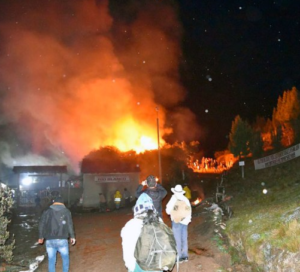
Rio Blanco mining camp burns

Heated clashes occurred between community members and security forces at Ecuagold's Chinese owned Río Blanco mine this past week, with several arrests being made and reports that 3 leaders of the Ecuarunari, the national confederation of the Kichwa people, were abducted by mine workers. This mine is one of Ecuador's five strategic mining projects and is currently in the exploitation phase, and is located in the western area of ​​Azuay. The mine has proven reserves of 2.1 million tons of mineralized rock, and is expected to obtain 605,011 ounces of gold and 4.3 million ounces of silver. The useful life of the mine will only be 11 years.

The governor of the province of Azuay, Xavier Enderica, said people outside of the community were responsible for the violence.

As of May 16, 2018, approximately 42 Protected Forest Reserves are threatened by mining concessions.


Members of The Women's Front in Defense of Mother Earth protest against the Rio Blanco mine.

Local community members dug ditches to restrict access to the Rio Blanco mine.

Locals (led by seven indigenous communities and campesino groups) alongside conservationists, are concerned about the impacts of mining on the water sources of the area. They have rejected a request for formal talks and insist this project be permanently stopped, having opposed the mine for the last 16 years. In addition, the community members who were part of the protests issued a statement. There, they asked the citizens of the province and the country to join in the defense of water and demanded "the immediate reversion of mining concessions in Rio Blanco and the entire national territory".


Growing militarisation - 200 policemen and 100 soldiers guard the Chinese owned Rio Blanco mining camp following protests


Militarised mining in Papua - This is what an "investor-friendly mining regime" actually looks like.